CONTRÔLE DE CONFORMITÉ DE PRODUITS AGROALIMENTAIRES
In the agri-food sector, the appearance of products is an essential criterion. Beyond taste, visual consistency is a guarantee of quality for the consumer... and a strong requirement for distributors. A sausage manufacturer cannot deliver trays containing products of irregular sizes. A difference in length or filling can lead to non-conformities, product returns, or a degradation of brand image.
PROJECT COMPLEXITY
- High cadence : 250 sausages per minute
- Multiple references : control to be adapted to many varieties of sausages
- Material constraints : CODA had to install a camera on aging equipment that could generate communication issues
The former integrator was no longer able to meet the client's needs. CODA Systems was therefore called upon to take over the project and integrate a new solution into an existing machine, replacing an obsolete system.
METHODOLOGY
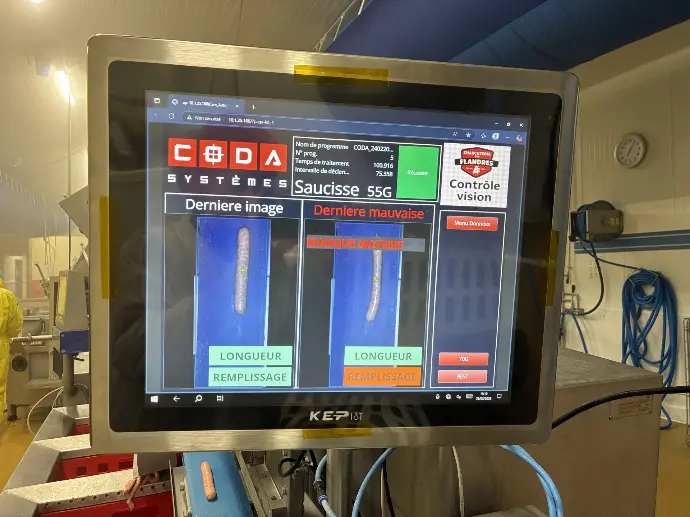
To ensure product compliance, our engineer has implemented a double dimensional control based on :
- The length of the sausage
- The projected area (square area) used to assess the fill level
The combination of these two measures allows for precise detection:
- Sausages that are too short or too long
- Filling defects
The entire solution has been integrated into the existing equipment, taking into account mechanical constraints and throughput. The system has been calibrated to adapt to the different varieties produced, without slowing down the line.
RESULTS
The implementation of automated control has allowed:
- A more consistent and repeatable quality of control
- Respect des normes ISO dans l'agroalimentaire et de la certification IFS Food
- A reduction in human errors related to fatigue and high pace : improvement of working conditions
- Quickly profitable solution, adapted to the pace and business constraints
A SIMILAR PROJECT ? CONTACT US !
CONTACT CODA