HIGH PRECISION 3D INSPECTION
FOR FOOD PACKAGING
In the food industry, the integrity of corking is a critical point in the production chain. A poorly screwed or non-compliant cap can lead to leaks, product contamination, and costly batch recalls. For this leader in the design of filling and capping machines dedicated to the packaging of liquid products, the challenge is to integrate control systems capable of adapting to the diversity of formats without compromising the speed..
THE CHALLENGE
Versatility and Multi-Format Precision.
The expertise of CODA Systèmes was requested to secure the line exit of a bottle filling machine.
The system was supposed to be able to process:
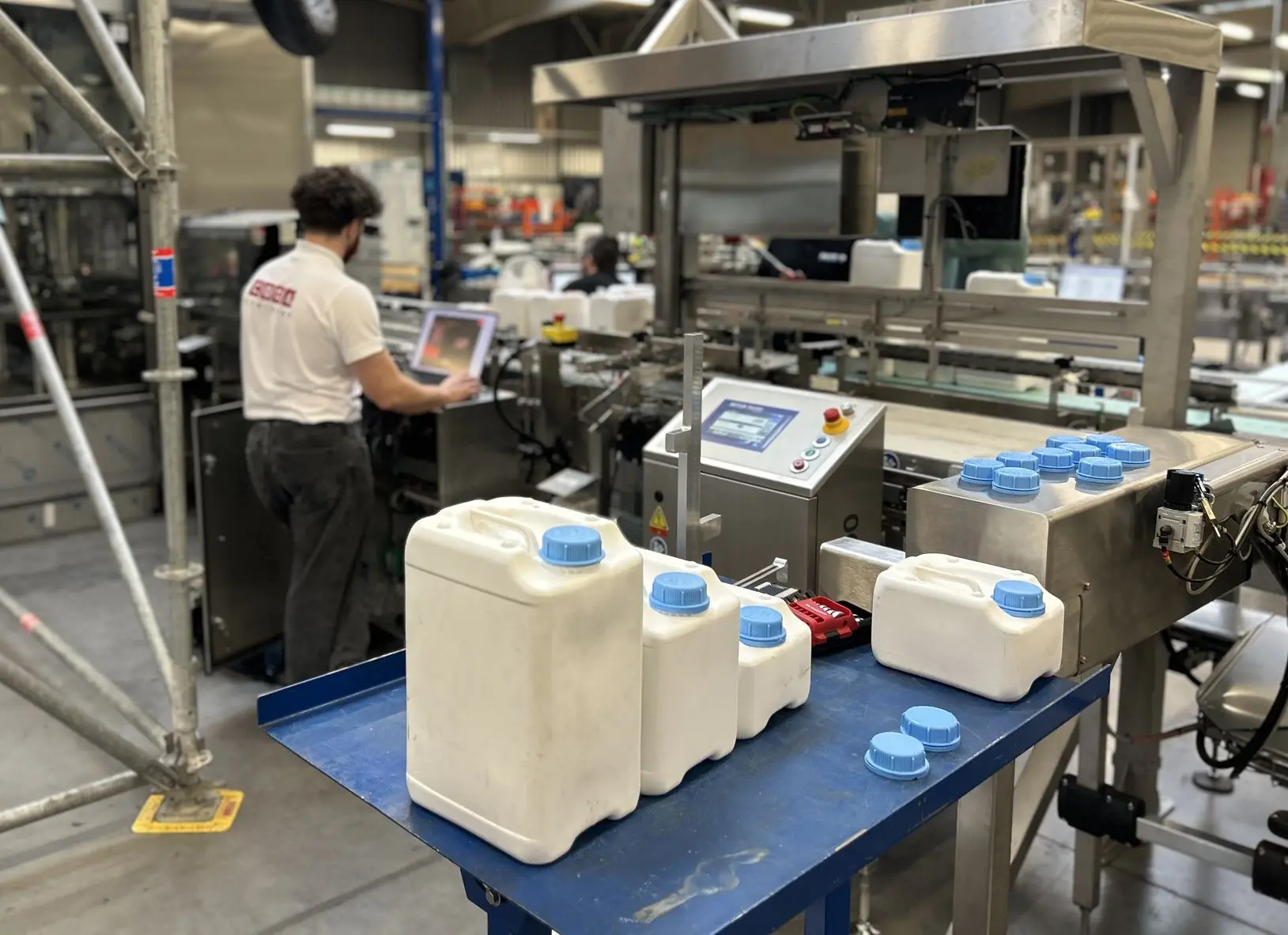
- 3 different sizes of containers involving significant height variations.
- Several models of caps, requiring automatic format identification to adapt the control criteria.
- A complex screwing check: verification of the angle and position (residual height) to detect cross-threaded or improperly engaged plugs.
Classic 2D vision systems reached their limits when faced with changes in perspective and variations in the height of the barrels.
PROJECT COMPLEXITY
• Floating reference: With the height of the cans varying, it was impossible to use a fixed control area.
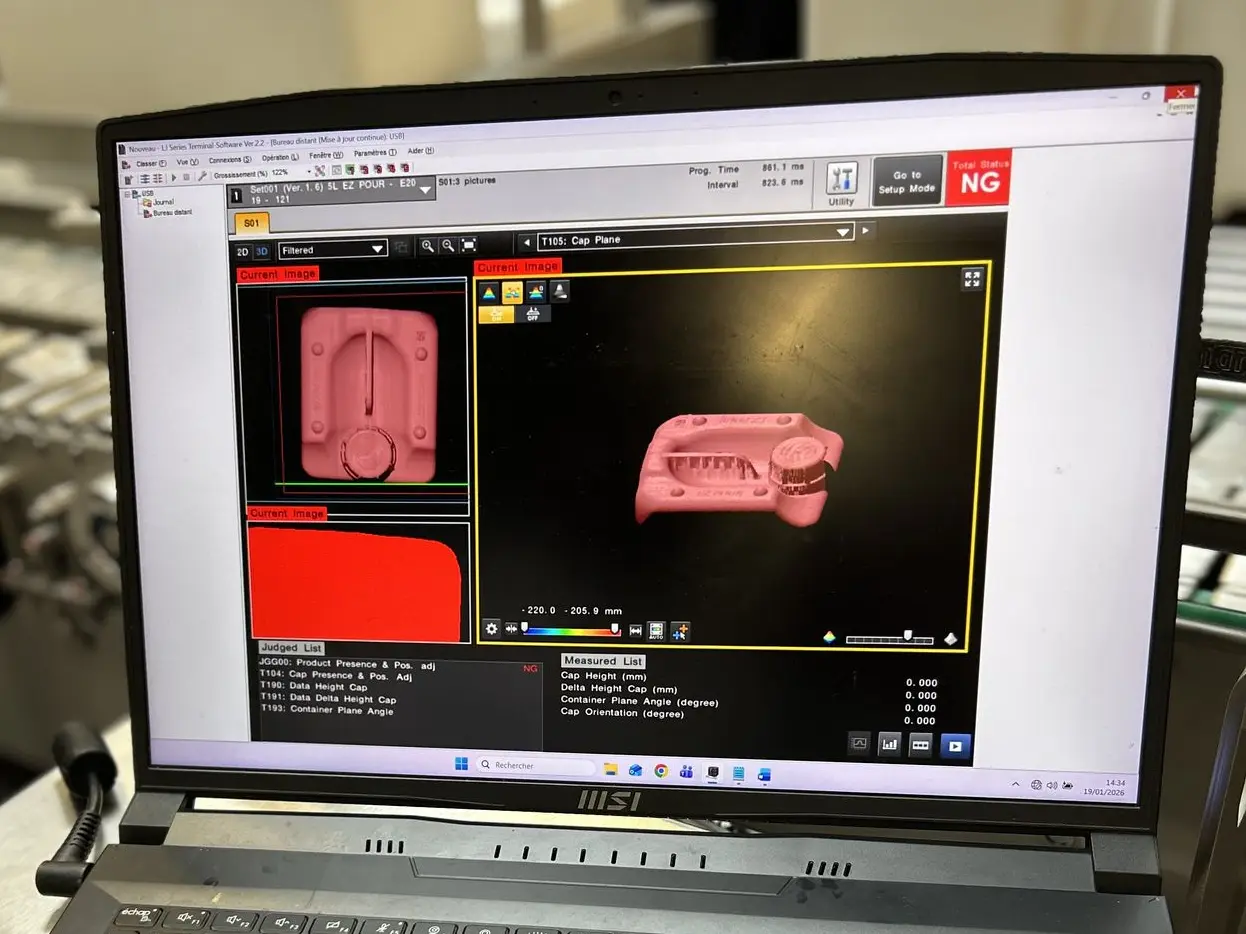
• Detailed dimensional analysis : The system must calculate the "delta" between the top of the canister and the top of the cap to validate the screwing..
• Intelligent Communication : The system must not only control but also identify the cap model to send the correct information to the automated system. (PLC).
• Agri-food Environment : Need for a robust, reliable, and fast solution.
THE METHODOLOGY
To overcome the variations in height of the containers, our engineers have developed a specific algorithm :
2. Creation of a dynamic reference plan
To overcome the variations in height of the containers, our engineers have developed a specific algorithm :
1. Base identification: The sensor scans the top of the container (the shoulder) to create a 3D reference plane .
2. Differential measurement: The system then calculates the height of the cap relative to this specific reference plane .
3. Tilt Analysis: Using the 3D point cloud, the system checks the angle of the cap to detect any "cross-threading".
1. 3D Vision Technology Implementation
Rather than a simple light-sensitive 2D image, CODA Systèmes recommended the installation of a 3D laser profilometer. This technology projects a laser line and analyzes the profile's deformation to recreate an ultra-precise 3D relief image.
3. Automatic pattern recognition
The system integrates a 3D shape recognition tool that identifies the specific profile of the cap used, allowing for the instant loading of associated tolerances without manual changes..
RESULTS
• Total security : Elimination of leak risks related to poor corking, regardless of the produced reference.
• Maximum flexibility : Transparent management of 3 bottle formats and multiple cap models on a single machine.
• Data optimization : Real-time information feedback to the machine for precise line control.
The expertise of CODA Systèmes: By transitioning from pixel analysis (2D) to spatial coordinate analysis (3D), we install a universal and robust control solution capable of adapting to future developments in their range of containers.
ONE QUESTION ?
If you would like to share a project or need more information, our team is at your disposal..
CONTACT CODA