TRACKING OF CONTAINER CAPS
Our client, a leader in the design of filling and capping machines, wanted to integrate control systems capable of adapting to the diversity of cap formats while maintaining a high production rate.
As part of this project, our client wanted to enhance the vision system on one of their machines to improve the tracking of caps.
THE CHALLENGE
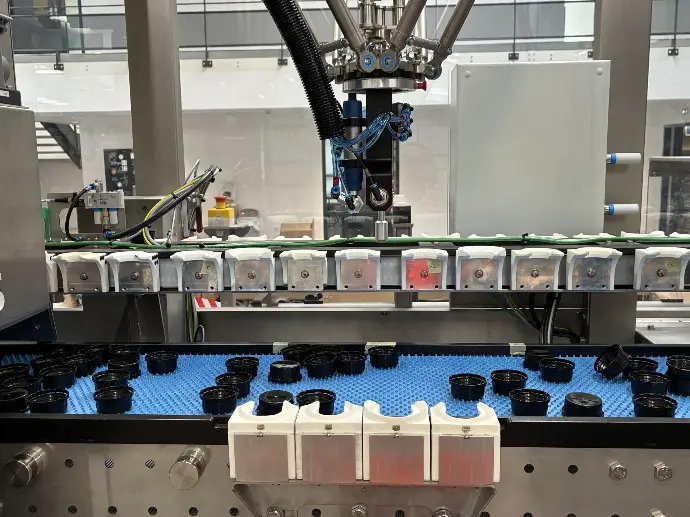
Until then, a 2D camera was used to detect the caps on the conveyor belt and determine their position in order to allow the robotic arm to place them in the slots.
The problem: the caps could sometimes stack on top of each other and make it impossible for the robot to pick them up.
With a 2D camera, it was then impossible to accurately distinguish the relief and height of the stacked caps. The system could no longer reliably determine their position, leading to the machine's stoppage, which prevented the machine from reaching the desired pace.
The client therefore called on CODA to evolve the existing vision system and find a solution capable of handling these situations while maintaining a high throughput.
PROJECT COMPLEXITY
The system was supposed to be capable of:
- Operate on 5 different cap diameters
- Ensure precise tracking of the caps
- Guide two robots simultaneously
- Maintain a rate of 60 caps per minute
METHODOLOGY
MOVE FROM 2D TO 3D
To overcome the limitations of the 2D camera, CODA chose to replace the existing vision system with a profilometer.
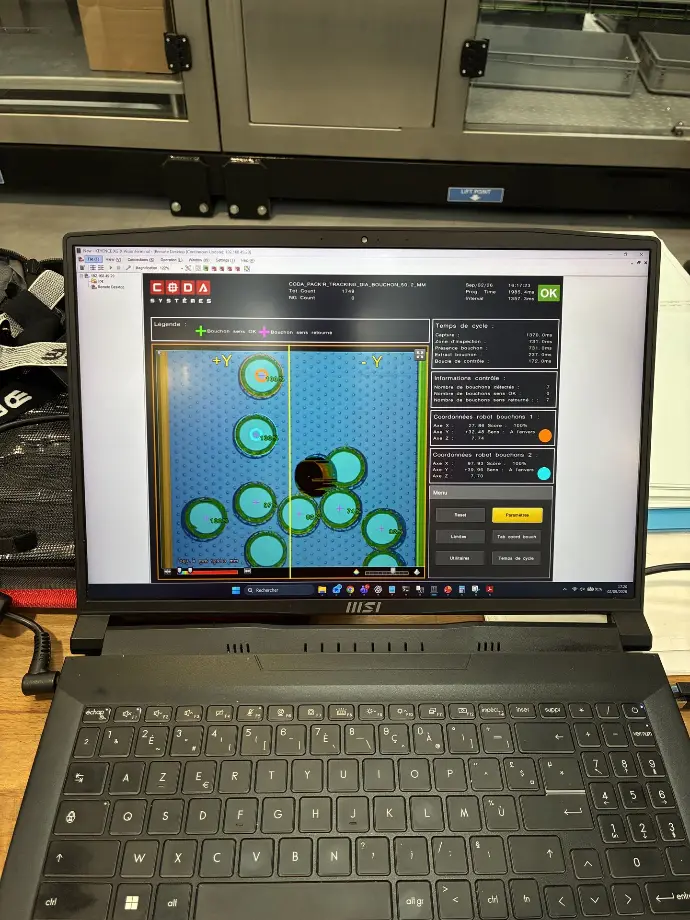
Why a profilometer? It allows us to capture the 3D image to better identify their position, increase the contrast, even when they are stacked. This was not visible in 2D.
- The profilometer analyzes the volume of the parts and then transmits the necessary information for the simultaneous guidance of the two robots.
- To manage the different formats, 5 vision programs have been developed, corresponding to the 5 diameters of caps.
- The solution was then integrated and commissioned on the machine, allowing the profilometer to track the caps and simultaneously guide two robots at a rate of 60 caps per minute.
RESULTS
By evolving the 2D vision system into a 3D solution, CODA Systems has enabled its client to:
- Ensure reliable tracking of bottle caps
- Increase one's pace
- Make its system scalable to new standards
An evolution that allows industrial vision to adapt to the real constraints of the machine, and not the other way around.
Technical FAQ
A 2D camera primarily analyzes a flat image, while a profilometer measures the profile and surface features of parts. In the case of cap tracking, this additional information helps to better identify stacked caps and ensures their reliable handling by the robot.
Yes. The same vision system can transmit the necessary information for guiding multiple robots. In this project, the profilometer allowed for tracking the plugs and guiding two robots simultaneously.
Yes. A vision system can be designed to upgrade an existing installation without necessarily starting from scratch. CODA can analyze the machine's operation, conduct feasibility tests, and select the most suitable technology before its integration.
A PROJECT?
If you would like to share a project or need more information, our team is at your disposal.
CONTACT CODA